Venetian mirrors in today's home
Murano glass, faceting, engraving and silvering read as workshop gestures, plus placement, light and the care an old mirror asks for.
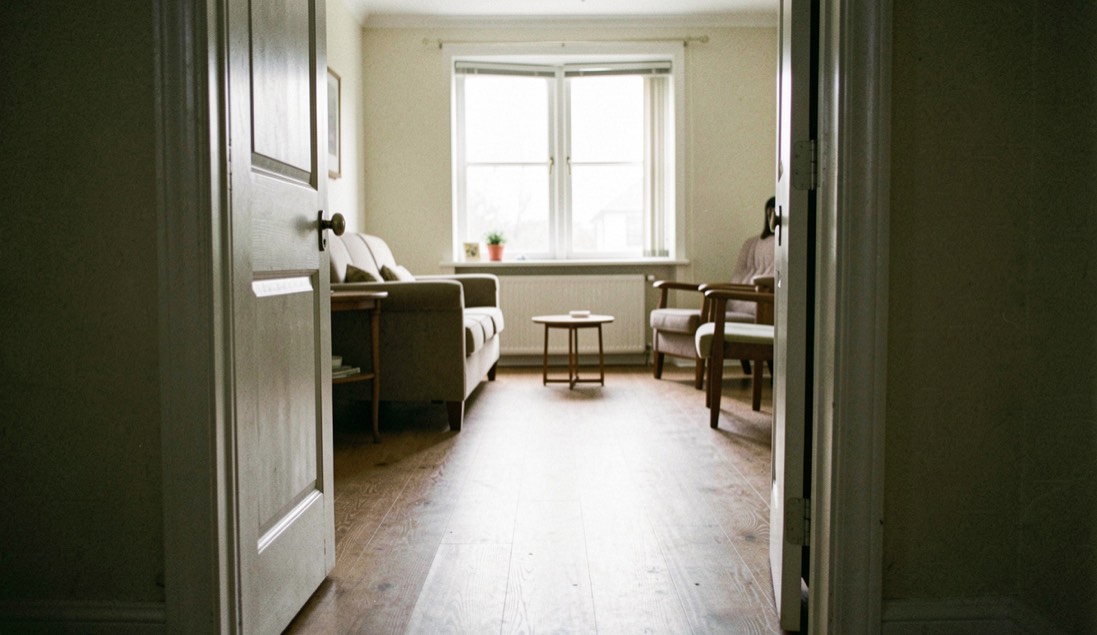
A Venetian mirror belongs to a room the moment it is hung, not the moment it is bought. Its Murano glass, its faceted edges, its engraved decoration and its silvered back are workshop gestures that keep acting on a wall: they bend daylight, repeat a window, darken a corner or open it. An old mirror then asks for specific care, because silvering, glass and frame age at different speeds and react to damp, heat and handling.
What makes a mirror Venetian rather than simply old?
The term describes a construction, not a nationality. A Venetian mirror is assembled from separate pieces of glass: a plain central plate, a border of shaped and faceted pieces, and often small decorative elements cut to fit the frame. The glass comes from the Venetian tradition of Murano, where the industry concentrated from the thirteenth century onward, and the pieces are joined rather than cut from one sheet.
That assembly is what produces the characteristic edge. A bevel or a facet is not decoration applied to the surface; it is a cut that removes glass at an angle, so the border catches light differently from the centre. Engraving works the opposite way, taking a shallow line or a pattern out of the surface with a wheel, so the mark reads as a pale drawing against the reflection. Silvering sits behind all of it, a metallic layer that turns the glass into a mirror and determines whether the reflection looks warm, cool, bright or slightly grey.
These three operations, faceting, engraving and silvering, are also the three things that most often need attention in an old piece. Anyone comparing venetian mirrors in an interior will notice that two mirrors of similar size and age can behave very differently on a wall, and the difference usually lies in how those operations were carried out and how they have aged.
Where should a Venetian mirror hang?
Placement is a lighting decision before it is a decorative one. A mirror shows whatever faces it, so the first question is what the room wants repeated. Facing a window, it doubles the daylight and can make a narrow room feel wider. Facing a blank wall, it repeats nothing and reads mainly as an object, which suits a heavily faceted or engraved piece whose own surface is the subject.
Height matters as much as direction. A mirror hung too high reflects ceiling and upper wall, which are usually the least interesting surfaces in a room. Hanging it closer to eye level, or aligning its centre with the middle of a doorway or a fireplace, keeps the reflection on things worth seeing. In a hallway, a mirror placed opposite the entrance catches arriving light and gives the space a second depth.
Avoid the two extremes that damage mirrors over time. Direct sunlight through a window can heat the glass unevenly and stress old silvering, and a position directly above a radiator or a working fireplace exposes the back to dry heat and soot. A wall that is bright but not sunlit, and warm but not hot, is the safer choice.
What do light and reflection change in a room?
A mirror does not add light; it redistributes it. A faceted border breaks a single reflection into many small ones, each angled slightly differently, so the edge of the mirror sparkles while the centre stays calm. That contrast is why a faceted mirror can sit in a plain room without looking busy: the activity is confined to the border.
Engraving behaves in the opposite way. Because it scatters light rather than reflecting it cleanly, an engraved motif appears as a soft, milky drawing that becomes more visible as the light behind the viewer increases. In a dim room the same motif almost disappears. This is worth remembering when choosing a wall: an engraved mirror needs a certain amount of ambient light to show what it is.
Silvering affects colour. Old mirrors often have a slightly warm or smoky tone because the metallic layer has aged, and that tone tints everything reflected in it. Some collectors value it; others prefer a clearer, cooler reflection. Neither is a fault, but the tone should be judged in the room where the mirror will hang, under the light it will actually receive, rather than in a shop or a photograph.
How is an old mirror maintained and conserved?
Dust is the main enemy, and it is best removed dry. A soft brush or a microfibre cloth used lightly on the glass, and a dry brush on the frame, will do more good than any liquid. Water and household glass cleaners are risky: liquid that reaches the edge of the glass can creep behind the silvering and lift it, and the damage is usually irreversible.
Frames need their own approach. Gilded wood, lacquer and painted surfaces react badly to solvents, so a frame should be cleaned with the least aggressive method that works, and tested first on a hidden area. Loose pieces of glass, however small, should not be pressed back into place by hand; the joint or the frame is usually what needs attention, and that is work for a conservator rather than an owner.
Environment matters more than cleaning. Stable temperature and moderate humidity slow the ageing of silvering, while damp rooms, kitchens and bathrooms accelerate it. If a mirror must be stored, it should stand vertically, padded at the edges, with nothing touching the glass surface, and it should not be laid flat where weight can distort the frame.
What should a buyer check before hanging one?
Look at the glass first, in daylight, from an angle. Small dark spots, a cloudy patch or a line of lifted silvering near an edge are signs of age that will not improve. Check that the faceted pieces are all present and that their edges are not chipped, since replacing a single shaped piece is difficult and matching old glass is harder still.
Check the frame for stability rather than beauty. A frame that flexes when lifted, or whose joints have opened, will not hold heavy glass safely on a wall. Ask how the mirror will be fixed: a large piece needs a fixing rated for its weight, attached to a solid wall or to a stud, not to plasterboard alone.
Finally, measure the wall before the mirror arrives. A Venetian mirror is usually wider than it appears in a photograph because of its border, and the space it needs includes room for the reflection it will throw. A mirror that fits the wall but not the light in the room will rarely look right, however good the glass.
For the history of the material and the workshop processes behind these objects, the Corning Museum of Glass maintains reference material on Venetian and Murano glassmaking that is useful for dating and terminology.
A working interior is read the same way as a facade: by its light, its use and its documents. Venetian mirrors multiply whatever daylight the room already holds, so their placement follows the plan rather than the wall. When the glass is to be kept and the services renewed, the sequence matters: survey, then scope, then the order of the lots. The decisions taken at that stage, recorded in a written brief and a set of drawings, determine what survives on site. For the method behind those documents, see briefing a renovation project.
Continue with architecture and design notes and the source register.